Showing posts with label Eggplant. Show all posts

Thursday, 6 June 2013

BACK TO EDEN VS ORGANIC HOMEMADE COMPOST

As some of you know, this year I've been trying one bed using the "Back to Eden", no-dig, wood chip method, and one using a blend of organic gathered material from around the property mixed with  conventional compost. I added the standard amounts of organic fertilizer and Epsom Salts to both beds to give the seeds a kickstart.

To be honest, although I had read about "Back to Eden" and seen many photos, a part of me believed that the leaf mould and gathered material would win hands-down.

How wrong I was!

From what I had gleaned, mostly skim-reading, because that's how I roll (I do dislike that phrase, it sounds phoney, so I use it very much in a silly, cheeky way), much of the praise for the wood chip method had been around the fact that the layer of chips holds in moisture and keeps plants moister for longer, extending the period of time between watering and thereby reducing the amount of water required, as well as reducing trauma to the plants from high heat on sunny days. There are other benefits too, but I was focusing on this point for now.

With this in mind, I wondered whether here on a tropical rainforest island, my main priority should be to  conserve moisture or protect from high day-time temps?  It rains heavily almost every night during the summer, but it can reach into the mid to high 90f/30c during the day. Somehow, my expectation for the wood chip vs the organic leaf litter fell in favour of the latter, after all that's how our lush forests have grown for centuries, unaided by humans?

'Tis a good thing I am not a betting woman, for I would have surely lost my stake money.

It seems the wood chips have another weapon in their armoury - the ability to soak up excess water; like little sponges they wick away the water from the soil, allowing it to evaporate more effectively. So, after many weeks of unprecedented rain for the time of year, the veggie beds were waterlogged.

In the red corner, the wood chips did their thing, whilst in the blue corner, the organic matter has turned into soup! And within that quagmire, few of the seeds have germinated and those that have seem to be drowning or rotting.

So, there you have it. It's not scientific - a trial of one! But see for yourselves. I am always ready to admit when I'm wrong.....so now all I have to do is wait for the right phase of the moon and thin some of these seedlings and set them some place else.

If you're interested in learning more about the "Back to Eden" you can visit their website or Facebook page (links below).

Now where can I find some more wood chips?.....

The "Back to Eden" style wood chip bed - 6 weeks after sowing

Tomatoes are now 5 - 6 inches/15cm high

Okra already about 12 inches/30cm high and every single one germinated


Eggplant/Aubergine, looking strong and healthy

The organic compost/leaf mould bed, looking very wet and a little sorry for itself

Chinese cabbage - whole row sown, less than half have germinated and barely an inch high
The Back to Eden Chinese Cabbage, sown at exactly the same time - now about 3 inches/8cm high with good germination

The leaf mould bed saturated with rain and run off from the rest of the garden


http://www.backtoedenfilm.com/
https://www.facebook.com/BackToEdenFilmOrganicGardening?fref=ts

Tuesday, 1 November 2011

MAN-GO....MAN-GONE


As we enter into November, I am taking every opportunity to make the most of the remaining weeks of what seems to have been a bumper 2011 avocado season.  I, like many others, will be sorry to see these wonderful, nutrition-rich beauties vanish for our daily menu.  And as if this was not woeful enough, the timing coincides with the end of our own mango trees fruiting; Julie, Palwee, Long, Pont (and a purple variety that none of us know the name of), have given up the last of their bounty for this year and are now busy erupting with new shoots of acid and lime green and deep coppery reds (these vary by variety).  The speed of growth is quite phenomenal - seemingly to grow several inches every day - and all over the island mango trees are bursting into flower and for some, next year's crop is already making an appearance as tiny, grape-sized specimens.  Sadly, I'm not a huge fan of freezing, drying or bottling this particular fruit, preferring to enjoy it simply and naked (the fruit, not me, though they're so juicy and sticky, that at times it seems that eating them naked would possibly be THE most sensible thing to do).


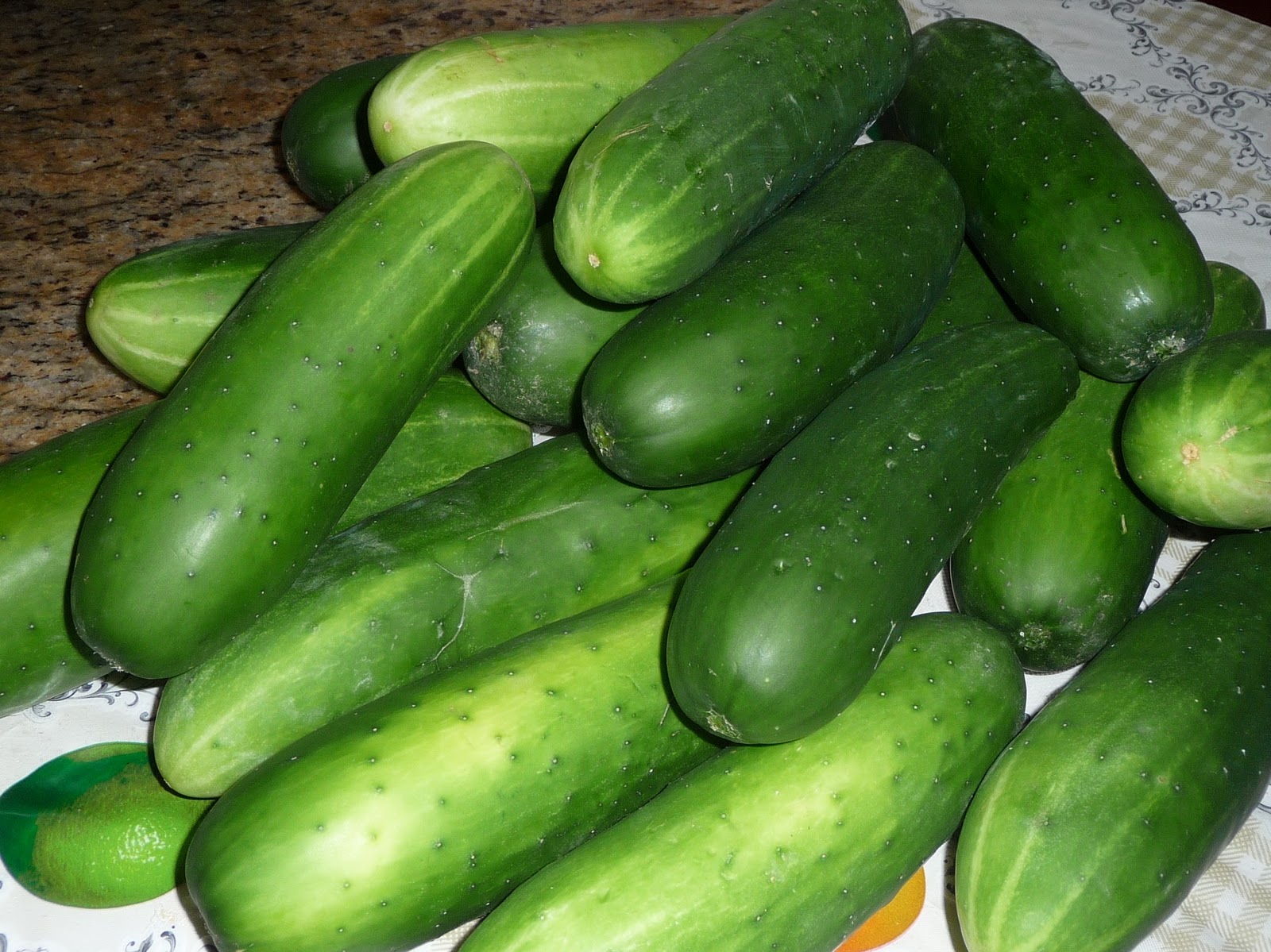
2011 has also brought a superb crop of cucumbers and the biggest challenge has been to use them all before they spoil. It's worth noting that the best specimens seem to grow on patches of land, recently cleared and burnt and left to settle for a week or two.  Eaten freshly picked, with a knife in hand and a tiny pile of ground sea-salt for dipping, is by far the best way to enjoy these, in my view; though thankfully, the results of my first efforts of bottling, pickling and even fermenting have proved to be most successful and produced some truly wonderful new taste sensations. Making the most of my father's seemingly endless supply of enormous home-grown limes, I've experimented with a range of marinades of sea salt, lime juice, rice vinegar, garlic, spring onions (scallions), fresh coriander (cilantro) and dried red chillies and used this to bottle some of these fabulously crisp cucumbers cut into thick spears. These (sealed in glass jars) last for several weeks in the fridge and make a superb accompaniment to a variety of hot and cold dishes and perfect with a hunk of good mature cheddar cheese and fresh crusty bread.  Finely sliced and blended with shredded, crunchy white cabbage and imported New Zealand Braeburn apples, they also make a rather delicious alternative twist on Korean Kimchee.  Hot, sweet and sour and packing a punch from a combination of fresh scotch bonnet peppers, dried red chillies and fresh garlic.  Equally, the addition of some chargrilled aubergines (egg plant) drizzled with extra virgin olive oil, adds yet another dimension - the possibilities seem endless.  
With further thoughts of bottling and pickling in mind, I am watching with interest as a new wild, self-seeded lime tree has burst into life.  I'm not sure how it came to be there, but it is now well established just beside the main driveway to the house.  Hopefully, it will go on to produce masses of small, juicy fruit, known here simply as "local lime", which are the perfect size for making traditional Indian style lime pickle. In the meantime, I will beg my Indian friends for their mother's, aunt's or grandmother's secret recipes!  If anyone has a particularly good recipe that they would like to share, I would be very happy to hear from them.  And so, the experimenting will continue as I try to find new ways of using and saving all that the garden provides.  Of course, sharing and bartering is prolific here and exchanging produce with family and friends is a great way to make the most of one's harvest; there is of course the added bonus that in the process one may even manage to save seeds from varieties that one has not previously grown.

* MAN-GO.... MAN-GONE! one of those silly family sayings that we use, never really knowing how, or when, it found it's way into our vocabulary.  I'm sure that every family has them....sometimes many years after the original occasion has long since been forgotten.